

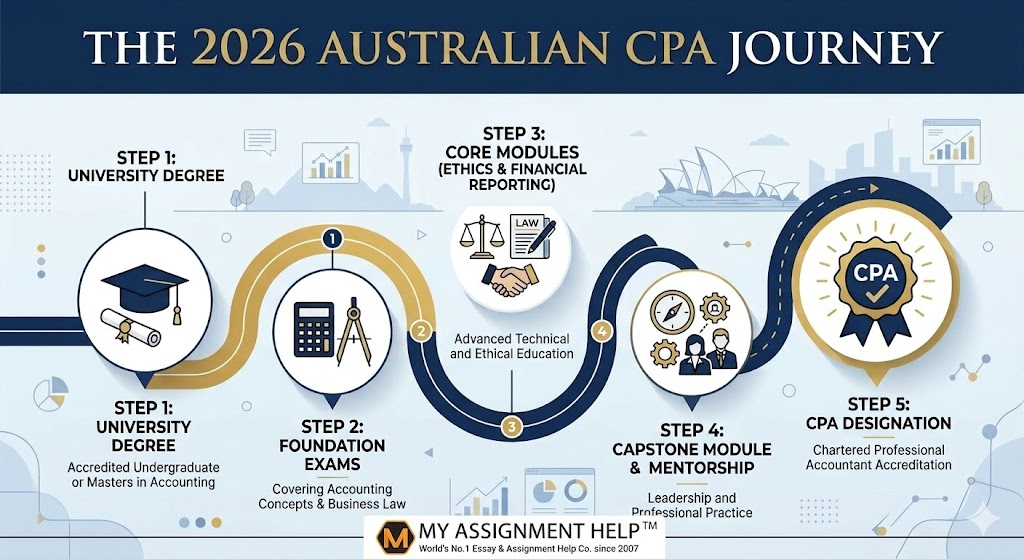
The Australian accounting landscape is undergoing a seismic shift. As we navigate through 2026, the traditional image of the “bookkeeper” has been entirely replaced by the “strategic advisor.” For students and graduates aiming for the prestigious CPA (Certified Public Accountant) designation, the bar has never been higher. With the integration of AI-driven auditing and the complexity of new ESG (Environmental, Social, and Governance) reporting standards, the journey to professional accreditation requires more than just numerical proficiency; it requires strategic resilience.
The 2026 Shift: Why the CPA Path is Changing
In 2026, the Australian Treasury and the Australian Accounting Standards Board (AASB) have implemented stricter transparency protocols. This has trickled down into the CPA Program and CA ANZ curricula, making “Advanced Taxation” and “Global Strategy and Leadership” modules significantly more intensive.
According to recent Labour Market Insights, the demand for accountants in Australia is projected to grow by 9.2% over the next five years, but the vacancy gap is specifically for those who can handle “High-Complexity Data Interpretation.” For many students, balancing a full-time internship with the rigorous CPA modules often leads to academic burnout. In these high-pressure scenarios, many domestic and international students in cities like Melbourne and Sydney find that seeking professional assignment help is a practical way to maintain their Grade Point Average (GPA) while gaining practical work experience.
Navigating the Complexity of CPA Assignment Help and Technical Standards
The difficulty of the CPA journey in 2026 stems from three primary pillars, particularly regarding technical compliance:
- Revenue Recognition (AASB 15): Mastering the five-step model for revenue from contracts with customers remains one of the most cited reasons students seek external support. The nuance required for contract modifications and performance obligations in a digital economy is immense.
- Financial Instruments (AASB 9): The shift toward the “expected credit loss” (ECL) model continues to challenge candidates. Understanding the classification and measurement of financial assets requires a level of mathematical precision that goes beyond basic ledger entry.
- Climate-Related Financial Disclosures: Australia is now a global leader in mandatory climate reporting. Accounting students are now expected to quantify carbon footprints as financial liabilities—a concept that didn’t exist in core textbooks a decade ago.
Bridging the Knowledge Gap with Accounting Assignment Help Australia
The transition from a Bachelor’s degree to the Professional Level of the CPA program is often described as a “vertical climb.” Research indicates that 40% of candidates struggle specifically with the Financial Reporting and Strategic Management Accounting segments due to the heavy emphasis on case-study analysis rather than rote learning.
For those looking for deep-dive technical breakdowns on these specific subjects, exploring expert resources like this accounting assignment help guide can provide the necessary edge in understanding the AASB framework and Australian tax law nuances.
Key Takeaways for Aspiring CPAs
- Embrace Tech-Fluency: Proficiency in Xero, MYOB, and advanced data visualisation tools is no longer optional.
- Focus on ESG: Understanding sustainability reporting is the fastest way to stand out to “Big Four” recruiters in 2026.
- Strategic Support: Utilising academic resources early in the semester prevents the “exam-week crunch” that leads to failure in high-stakes modules.
- Networking: Join CPA Australia’s “Young Professionals” committees to understand the “hidden” job market.
Frequently Asked Questions (FAQ)
1. Is the CPA Australia exam harder in 2026?
The exam has shifted from testing memory to testing “Professional Judgement.” While the pass marks remain consistent, the application-based questions require a much deeper understanding of commercial law and ethics.
2. Why is AASB 15 considered so difficult for students?
AASB 15 requires identifying distinct “promises” within a contract. In modern SaaS or service-based industries, separating these obligations for revenue recognition is highly subjective and technically demanding.
3. What is the average salary for a CPA in Australia in 2026?
Recent data suggests that a newly qualified CPA in Australia can expect a starting salary ranging from $85,000 to $105,000 AUD, depending on the sector and location.
About the Author
Kara Betty is a Senior Academic Consultant at MyAssignmentHelp, specialising in Australian Financial Law and Taxation. With over 8 years of experience in the EdTech sector, Liam has mentored thousands of students through the complexities of the CPA Australia and CA ANZ curricula. He holds a Master’s in Professional Accounting and is a frequent contributor to academic journals focusing on AASB 9 compliance. Connect with Kara: Professional Profile / LinkedIn
References:
- CPA Australia (2026) – “The State of the Profession Report.”
- Australian Accounting Standards Board (AASB) – “AASB 15 & AASB 9 Technical Guides.”
- National Skills Commission – “Accountancy Labour Market Insights 2026.”













Leave a Reply